Through The Cigna Group’s Impact Accelerator Program, employee volunteers apply their professional expertise to nonprofit challenges while strengthening collaboration, adaptability and problem-solving capabilities.

Key takeaways
- Skills-based volunteering connects nonprofit organizations with employees who can apply specialized expertise to operational and organizational challenges.
- The Cigna Group’s inaugural 12-week Impact Accelerator Program brought together employee volunteers to support three grantees of The Cigna Group Foundation.
- The project addressed challenges involving data and reporting, referral and admissions tracking, and client intake processes.
- Well-designed employee volunteer programs can provide practical opportunities for employees to strengthen human capabilities such as collaboration, creativity, adaptability, and problem-solving.
Nonprofits are focused first and foremost on serving their communities, often with limited time and resources to invest in the systems and operations that support their work. Skills-based volunteering can help address that need by connecting nonprofits with employee volunteers who bring relevant professional expertise.
Through The Cigna Group’s 12-week Impact Accelerator Program, employee volunteers partnered with three nonprofit grantees of The Cigna Group Foundation to address distinct operational challenges.
Working in cross-functional teams, employees applied their skills in areas such as data analysis, process improvements, workflow design, automation, and change management. The projects were designed to leave each nonprofit with practical tools, recommendations, or processes it could continue using after the engagement ended. For employee volunteers, the program offered an opportunity to apply their expertise in a new setting, collaborate with colleagues across the company, and strengthen capabilities that remain essential as technology changes how work gets done – such as creativity, adaptability, and problem-solving.
What is skills-based volunteering?
Skills-based volunteering is a form of service in which employee volunteers use professional knowledge, technical capabilities, or workplace experience to help a nonprofit address a defined organizational need.
Projects may draw on expertise in data analysis, communications, technology, finance, process improvement, or strategic planning. Unlike traditional hands-on volunteering, skills-based service focuses primarily on strengthening the systems and operations that help nonprofit organizations advance their missions.
This model can benefit employees, employers, and nonprofits on several levels. Nonprofits gain access to expertise that may be difficult to fund or staff internally. Employee volunteers apply familiar skills in a new environment, learn from colleagues outside their regular teams, and approach problems from a different perspective. Employers can offer a professional development experience grounded in purpose and real-world problem-solving.
How does The Cigna Group’s Impact Accelerator Program work?
The Cigna Group created the Impact Accelerator Program in partnership with Taproot Foundation to connect employee skills with practical challenges identified by nonprofit partners.
Each project began with the nonprofit’s needs. Volunteer teams then developed practical tools, processes, or recommendations intended to support the organization beyond the program itself.
The 12-week pilot was conducted virtually, allowing employee volunteers from different functions and locations to participate in cross-functional teams.
Employee volunteers contributed experience in areas including:
- Data analysis and reporting
- Dashboard development and data storytelling
- Systems thinking and process improvement
- Workflow design and automation
- Business development strategy
- Change management
“[The Impact Accelerator Program] has been one of the most rewarding experiences I’ve had at The Cigna Group. It provided an opportunity to contribute to a cause greater than ourselves, collaborate with amazing people, and develop both personally and professionally.” John B., operating effectiveness manager at The Cigna Group
How did employee volunteers support nonprofit partners?
Each Impact Accelerator project focused on a different operational need, but all three shared a common objective: help nonprofit partners strengthen their capacity to serve their communities.
Turning data into clearer decisions for retired service members
Air Force Enlisted Village, located in Northwest Florida, provides independent housing, senior resources, and a supportive community for retired enlisted Air and Space Force members and their surviving spouses.
The employee volunteer team applied experience in data analysis, reporting, dashboard design, data storytelling, and systems thinking to help the organization explore ways to make its data more useful and actionable. The work was intended to support clearer, data-informed decisions for the people who rely on the organization’s services.
“Participating alongside Air Force Enlisted Village was an amazing experience. Not only were we given the opportunity to demonstrate our business value in a way that felt especially meaningful, but we also established new relationships throughout this process that made this experience that much more rewarding.” Shandelle C., operations senior manager, Evernorth
Strengthening referral and admissions tracking for recovery services
Harris House Foundation, based in St. Louis, provides treatment and recovery services for people experiencing substance use disorders.
The employee volunteer team applied skills in business development strategy, process improvement, automation, and data-informed decision-making to strengthen the organization’s referral and admissions tracking. The work provided Harris House with clearer ways to monitor progress and better support people seeking recovery services.
“We had this big business issue that we threw at them, and they didn’t blink. They just took it and ran.” John M., CEO of Harris House Foundation
Creating a smoother path to mental health care
West Texas Counseling & Guidance, based in San Angelo, Texas, works to expand access to mental health care through evidence-based counseling and supportive services.
Employee volunteers helped redesign and standardize the client intake process using process mapping, workflow design, change management, reporting, and dashboard development. Their recommendations are intended to improve the client and staff experience and create a smoother path for people seeking care.
“It gave us the time to step back and have other highly skilled people help us get that outside perspective. What they sent us after 12 weeks of work is something we’re going to be able to implement and make a real difference for the people we serve.” Jannell T., COO of West Texas Counseling & Guidance

Pictured above: Employee volunteers from The Cigna Group help West Texas Counseling & Guidance improve their intake process through process mapping.
What makes a skills-based volunteer program effective?
The Impact Accelerator pilot highlighted several practical principles for designing and running a skills-based volunteer program:
- Begin with a nonprofit-defined challenge. Projects should respond to the partner’s priorities rather than assumptions about what it needs.
- Match expertise to the work. Employee volunteer capabilities should align to the specific challenge and intended deliverables.
- Create structure without taking ownership away from the partner. Clear roles, timelines, and checkpoints can keep work moving while ensuring the nonprofit remains central to decisions.
- Listen before proposing solutions. Teams need to understand the organization’s real-world constraints, goals, and operating environment.
- Focus on practical deliverables. Recommendations, tools, and processes should be realistic for the nonprofit to use after the engagement ends.
- Use virtual participation to expand access. A virtual model can connect nonprofit partners with employees across functions and locations.
What does The Cigna Group’s Vitality and Volunteerism research reveal?
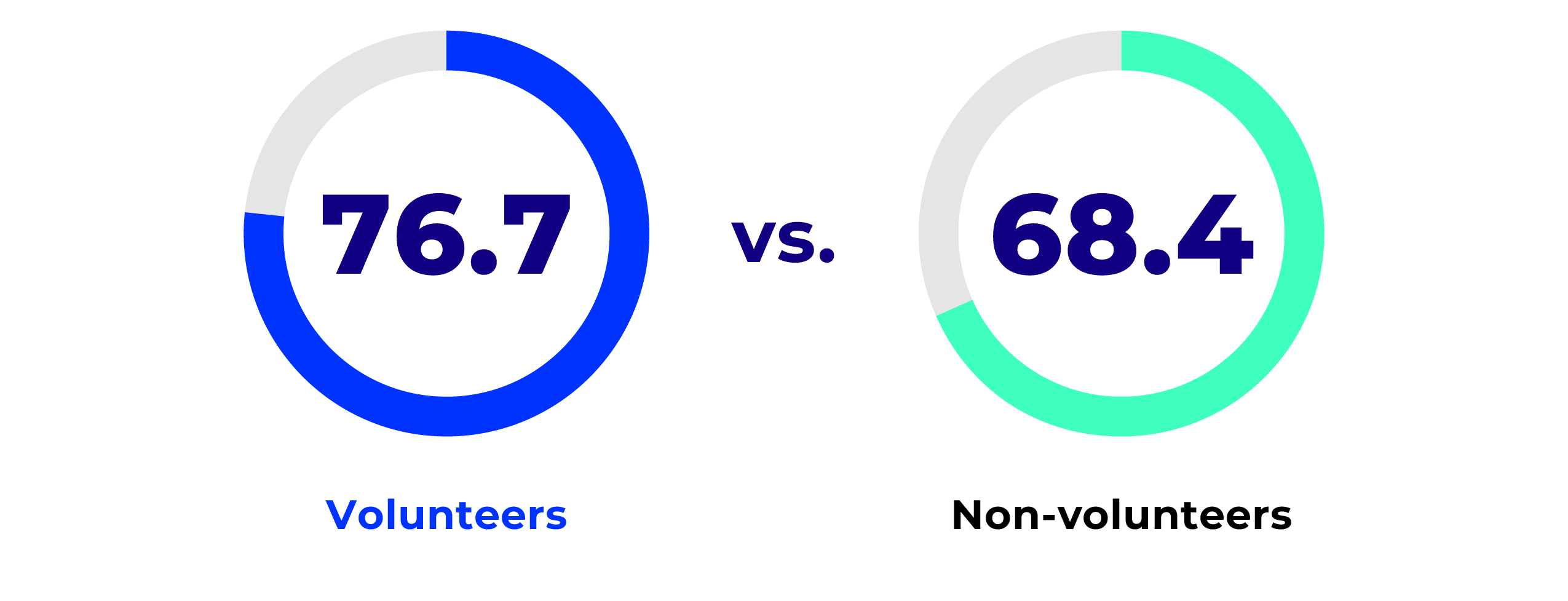
According to The Cigna Group’s Vitality and Volunteerism research, people who volunteer report substantially higher vitality than those who do not volunteer. They also report stronger physical health, a greater sense of purpose, higher resilience, and a more positive outlook on life.
These qualities are core to nurturing a productive and engaged workforce, as employers look for ways to help employees navigate change, manage stress, and stay connected to their work and one another.
Evernorth Vitality Index score (out of 100)
The Cigna Group’s Vitality and Volunteerism research also found connections between employer-supported volunteerism and the workplace. Employees who participate in employer-supported volunteer opportunities report higher job satisfaction, stronger workplace relationships, greater commitment to helping their organization succeed, and higher levels of pride in their employer.
The Impact Accelerator Program provides an example of how these benefits can take shape. Employee volunteers apply professional expertise to community challenges while collaborating across functions and building relationships with colleagues they might not otherwise have worked with. Those experiences reflect several workforce outcomes highlighted in The Cigna Group’s Vitality and Volunteerism research, including stronger sense of connection, purpose, and engagement.
The Cigna Group’s Vitality and Volunteerism research also found that many employees would participate in volunteer opportunities if employers made them available and easier to access. For organizations seeking to strengthen workforce vitality while creating positive community impact, employer-supported volunteerism represents an opportunity to invest in people, culture, and communities at the same time.
Common questions about skills-based volunteering
Skills-based volunteering allows people to use professional expertise, such as data analysis, communications, process improvement, technology, or business strategy, to help a nonprofit address a specific organizational challenge.
Traditional volunteering often focuses on hands-on service, such as supporting events, organizing supplies, or participating in community activities. Skills-based volunteering uses professional expertise to address operational or organizational needs.
Both forms of service can support nonprofit missions. Skills-based projects typically focus on helping an organization strengthen its internal capabilities over time.
The Impact Accelerator Program is a 12-week skills-based volunteer initiative that pairs cross-functional employee teams with nonprofit partners. In the pilot, employees provided virtual support to three grantees of The Cigna Group Foundation.
The initial pilot supported three nonprofit organizations:
• Air Force Enlisted Village
• Harris House Foundation
• West Texas Counseling & Guidance
Skills-based volunteering can provide targeted expertise to improve data use, workflows, reporting, planning, and other core functions. This support can help nonprofit teams devote more time and resources to their missions.
Skills-based volunteering can give employees an applied development experience that strengthens collaboration, adaptability, creativity, communication, and problem-solving. Employers can use these programs to connect community impact with employee growth and workforce development.
Effective programs begin with a challenge defined by the nonprofit, match employee volunteers with the skills the project requires, and establish clear roles, timelines, and deliverables. Volunteer teams should listen to nonprofit partners before recommending solutions and develop tools or processes that are realistic for the organization to sustain.
The Cigna Group’s Vitality and Volunteerism research suggests volunteerism can benefit both employees and employers. Volunteers report higher vitality and stronger well-being, while employees who participate in employer-supported volunteer opportunities report greater workplace engagement, stronger relationships with colleagues, and higher levels of pride in their organization.
The Cigna Group’s Vitality and Volunteerism research found that employees who participate in employer-supported volunteer opportunities report higher job satisfaction, stronger workplace relationships, greater commitment to helping their organization succeed, and higher levels of pride in their employer.

Download The Cigna Group’s Vitality and Volunteerism research (PDF)
Learn more about a powerful opportunity for employers to strengthen workforce engagement, performance, and retention.